

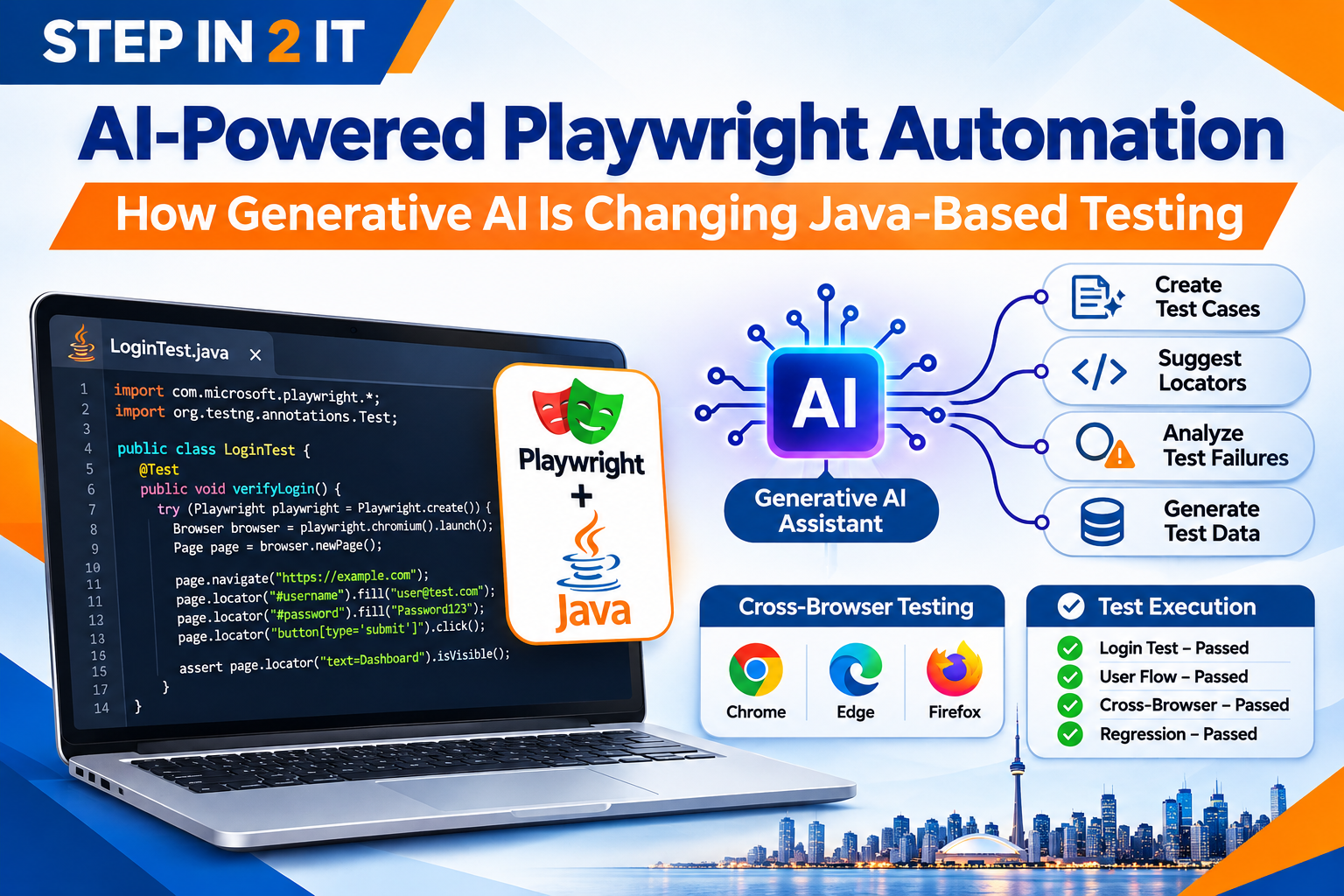
Discover how Generative AI, Java and Playwright are creating new opportunities for modern software testing.
Software testing is entering a new phase. Artificial intelligence is no longer limited to helping developers write code or answer technical questions. It is increasingly becoming part of the software testing lifecycle.
For years, QA automation engineers have followed a structured approach: understand business requirements, prepare test cases, identify application elements, write automation scripts, execute tests and investigate failures.
Although this approach remains important, Generative AI is introducing new ways to perform many of these activities.
Imagine providing an AI assistant with a user story and asking it to generate functional test scenarios, create Java-based Playwright scripts, suggest locators, generate test data and explain automation failures.
This is becoming possible through the combination of Generative AI, Java, Playwright and AI-assisted development tools.
For QA professionals, the opportunity is not to let AI replace testing knowledge. It is to learn how to use AI to improve productivity, test coverage and automation quality.
1. What Is AI-Powered Playwright Automation?
AI-powered Playwright automation combines browser automation capabilities with artificial intelligence tools that assist in designing, developing, executing and maintaining automated tests.
Playwright provides the browser automation foundation. Java provides the programming environment for building reusable automation frameworks. Generative AI helps engineers create, analyse and improve test automation assets.
- Playwright: Automates browser interactions, navigation, form submissions, assertions, API requests and cross-browser testing.
- Java: Provides object-oriented programming, reusable framework components, test execution and integration capabilities.
- Generative AI: Helps generate test scenarios, suggest code, analyse failures, create test data and explain technical problems.
- QA Engineer: Reviews requirements, validates business logic, designs meaningful assertions, evaluates risks and ensures that the final tests are reliable.
The result is an AI-assisted automation workflow in which engineers spend less time on repetitive coding tasks and more time on test strategy, quality analysis and complex testing challenges.
2. How Generative AI Is Changing the Software Testing Lifecycle
Generative AI can support several stages of the software testing lifecycle.
A. AI-powered test case generation
Traditionally, QA engineers manually analyse requirements and convert them into test scenarios. Consider this user story:
A QA engineer may need to create scenarios covering:
- Successful login with valid credentials.
- Login with an incorrect password.
- Login using an unregistered email address.
- Empty email and password fields.
- Invalid email format.
- Account lockout after repeated failed attempts.
- Password visibility and masking.
- Session handling after successful authentication.
A Generative AI assistant can analyse the user story and propose these scenarios, together with additional edge cases. The engineer can review the suggestions, remove irrelevant cases and convert approved scenarios into automation scripts.
Business benefit: Faster test design and potentially broader scenario coverage, provided the generated cases are reviewed against actual requirements.
B. AI-assisted Java test script generation
Writing repetitive automation code can consume considerable development time. Generative AI tools can help create initial Java-based Playwright scripts from plain-language instructions.
For example, a tester could ask an AI assistant to create a Playwright Java test that opens an application, enters valid login credentials, clicks Login and verifies that the dashboard heading is visible.
import com.microsoft.playwright.*;
import static com.microsoft.playwright.assertions.PlaywrightAssertions.assertThat;

public class LoginTest {

    public static void main(String[] args) {

        try (Playwright playwright = Playwright.create()) {

            Browser browser = playwright.chromium().launch();

            Page page = browser.newPage();

            page.navigate("https://example.com");

            page.locator("#email").fill("user@example.com");

            page.locator("#password").fill("Password123");

            page.locator("button[type='submit']").click();

            assertThat(page.locator("h1"))
                .hasText("Dashboard");

            browser.close();
        }
    }
}
This is an illustrative starting point. The application URL, selectors, credentials and expected heading must be adapted to the actual application. The QA engineer should review the generated code, validate the locators, protect credentials and integrate the test into the project's existing framework.
C. Intelligent locator suggestions
Finding reliable web elements is one of the most important parts of automation development. Traditional automation scripts frequently use CSS selectors, XPath expressions, IDs and class names. Poorly designed locators can become difficult to maintain when application interfaces change.
Generative AI can assist engineers by analysing available DOM information, accessibility information and application structure to suggest suitable locators.
page.getByRole(
    AriaRole.BUTTON,
    new Page.GetByRoleOptions().setName("Login")
).click();
This is often preferable to relying on a long, deeply nested XPath when the application's accessible role and name are stable.
Playwright already provides locator strategies such as role-based, label-based, placeholder-based and test-ID locators. Its built-in Codegen tool can also record browser interactions and recommend locators. AI assistants can complement these features by helping engineers understand and improve the generated code.
D. AI-powered test data generation
Test data preparation is another activity where Generative AI can assist QA teams. Consider an application that requires testing customer registration. A tester may need different combinations of valid email addresses, invalid email formats, strong and weak passwords, missing mandatory fields, boundary values and duplicate registration details.
An AI assistant can help generate structured test data based on defined business rules.
String validEmail = "qa.test@example.com";
String invalidEmail = "qa.test";
String emptyEmail = "";
String weakPassword = "12345";
String strongPassword = "Test@2026Secure";
For larger test suites, AI can assist in preparing JSON datasets, CSV records and parameterized test inputs. Generated data should be validated before execution. Teams should avoid entering real customer information, personal information or confidential production data into unapproved AI services.
3. Building an AI-Assisted Playwright Framework with Java
The real value of AI-powered automation becomes more apparent when it is integrated into a structured automation framework.
Essential framework components
- Java programming: Provides the foundation for object-oriented programming, reusable methods, exception handling and framework architecture.
- Playwright: Handles browser automation, element interactions, navigation, screenshots, browser contexts and API testing.
- TestNG or JUnit: Provides test execution, assertions, lifecycle management, grouping and parallel execution.
- Maven: Manages dependencies, project configuration and build execution.
- Page Object Model: Separates page interactions from test scenarios and improves framework maintainability.
- Generative AI tools: Help generate initial test scripts, suggest reusable methods, review code and explain failures.
- CI/CD integration: Jenkins, GitHub Actions and Azure DevOps can execute automation tests as part of continuous integration and delivery workflows.
Example: A practical AI-assisted workflow
Imagine a QA engineer receives a requirement for an e-commerce application. The requirement is to verify that customers can add products to a shopping cart and complete checkout.
- The QA engineer provides the user story and acceptance criteria to an AI assistant.
- The AI assistant proposes positive, negative and boundary test scenarios.
- The engineer reviews and approves the test scenarios.
- AI helps generate initial Playwright Java test methods.
- The engineer validates the locators and application-specific logic.
- The tests are integrated into the existing Page Object Model framework.
- Playwright executes the tests across the required browser engines.
- Failed executions are investigated using logs, screenshots and Trace Viewer.
- AI assists in explaining error messages and suggesting possible improvements.
- The engineer validates the corrections and commits the approved changes.
This workflow combines AI-assisted development with human-led quality engineering.
4. AI-Powered Debugging: Understanding Test Failures Faster
Debugging is one of the most time-consuming responsibilities of automation engineers. A failed test does not always indicate an application defect. It may result from an incorrect locator, synchronization issue, environment problem, unexpected test data or genuine application failure.
Generative AI can help engineers investigate these possibilities.
Example of AI-assisted failure analysis
Suppose a Playwright test fails because a Login button cannot be clicked. An engineer can provide the following information to an approved AI assistant:
- The Java test method.
- The Playwright error message.
- The relevant DOM snapshot.
- The locator being used.
- The expected application behaviour.
- Relevant execution logs.
The AI assistant may suggest checking whether the element exists, whether it is visible, whether another element is blocking it, whether the locator matches multiple elements, whether the application has completed loading and whether the button is disabled.
Playwright's Trace Viewer is particularly useful because it provides an execution timeline, DOM snapshots, screenshots, network activity and other debugging information. AI can help interpret this information, but the engineer must establish the actual root cause before changing the test.
5. Generative AI and Playwright MCP: The Next Step in Browser Automation
One important development in AI-assisted browser testing is the Model Context Protocol (MCP). MCP provides a standard way for compatible AI assistants to communicate with external tools.
Playwright MCP allows compatible AI agents to interact with browsers through structured browser information and tool calls. Instead of relying only on screenshots, an AI agent can work with structured accessibility information to identify page elements and perform browser interactions.
What can AI agents do with browser automation?
Depending on the connected tools, permissions and workflow, AI-assisted browser agents can help:
- Navigate web applications.
- Inspect page content.
- Identify interactive elements.
- Fill in forms.
- Execute user workflows.
- Verify expected page states.
- Investigate unexpected browser behaviour.
For example, a QA engineer could ask a compatible AI assistant to inspect a test application and help create an automation scenario for the customer registration process. The assistant can inspect the available page information, propose the interaction sequence and help produce automation code.
Important distinction: Playwright Java is the programming interface used to build Java automation solutions, while MCP is an integration approach that allows compatible AI agents to interact with browser tools. They can complement one another, but MCP is not a replacement for a Java testing framework.
6. Can Generative AI Replace QA Automation Engineers?
This is one of the most common questions among software testers. The short answer is no. Generative AI can automate or accelerate certain repetitive activities, but software quality engineering involves much more than writing test scripts.
A successful QA professional must understand:
- Business requirements.
- Application workflows.
- Risk-based testing.
- Positive and negative test scenarios.
- Boundary-value analysis.
- Exploratory testing.
- Defect identification and reporting.
- API and database validation.
- Test coverage and quality metrics.
- Security and privacy considerations.
AI can generate a test script, but it may not understand the complete business context or identify every important risk. For example, an AI-generated login test may verify that a customer can successfully sign in. A knowledgeable QA engineer may also consider account lockout, session expiration, role-based access, password reset, concurrent sessions and security requirements.
The strongest QA professionals will be those who understand testing fundamentals and know how to use AI effectively.
7. Important Skills QA Engineers Should Develop in 2027
As AI-assisted automation becomes more common, QA professionals should focus on developing a combination of technical and analytical skills.
| Skill | Why It Matters |
|---|---|
| Java programming | Builds reusable and maintainable automation frameworks |
| Playwright automation | Supports modern browser testing |
| TestNG/JUnit | Organizes and manages test execution |
| API testing | Validates backend services and integrations |
| Maven | Manages Java project dependencies and builds |
| Generative AI | Assists with test design, code generation and debugging |
| Prompt engineering | Helps communicate testing requirements effectively to AI tools |
| CI/CD | Integrates automated testing into software delivery |
| Git | Supports version control and team collaboration |
| Test strategy | Ensures meaningful coverage and risk-based testing |
QA engineers should also become comfortable reviewing AI-generated code, validating test assertions and identifying incorrect assumptions.
8. What Does This Mean for QA Automation Careers in Canada?
The Canadian technology sector continues to require professionals who can contribute to software quality, automation development and modern engineering workflows.
For candidates in Toronto and the Greater Toronto Area, combining Java, Playwright and AI-assisted testing can help develop a more versatile technical profile.
Employers may look for candidates with experience in:
- Java-based automation frameworks.
- Selenium and Playwright.
- API and UI automation.
- TestNG and JUnit.
- CI/CD pipelines.
- Agile and software development practices.
- AI-assisted development tools.
- Test planning and defect management.
Not every QA position requires Generative AI experience, and job requirements vary by employer. However, understanding how AI can support automation is a useful professional development opportunity.
For Selenium professionals, adding Playwright and AI-assisted development skills can help expand existing capabilities. For manual testers, Java and Playwright can provide a structured pathway into automation engineering. For new graduates, combining programming fundamentals, testing concepts and practical automation projects can help demonstrate job-ready skills.
9. How to Start Learning AI-Powered Playwright Automation with Java
If you want to move into modern automation testing, follow a structured learning approach.
- Build a foundation in Java: Understand variables, data types, loops, methods, object-oriented programming, collections, exception handling and interfaces.
- Learn software testing fundamentals: Understand test case design, functional testing, regression testing, integration testing, defect lifecycle and test documentation.
- Learn Playwright with Java: Practise browser launch, navigation, locators, assertions, browser contexts, dropdowns, alerts, frames, file uploads and downloads.
- Build an automation framework: Learn Maven, TestNG or JUnit, Page Object Model, reusable methods, configuration management and reporting.
- Integrate API testing: Learn how to validate HTTP requests, response codes, response bodies and backend application behaviour.
- Introduce Generative AI: Use AI coding assistants to generate initial test cases, improve Java code, explain exceptions and suggest test data.
- Work on practical projects: Build an end-to-end automation project covering login, registration, product search, shopping cart, checkout and API validation.
- Learn CI/CD and team workflows: Practise Git, Jenkins or GitHub Actions and understand how automated tests are executed within development pipelines.
This learning pathway helps candidates progress from basic browser automation to structured, AI-assisted quality engineering.
10. Learn Playwright with Java and AI-Assisted Testing at STEP IN 2 IT
At STEP IN 2 IT, we understand that technology skills must evolve alongside the software development industry.
Our Playwright with Java training is designed to help candidates develop practical automation capabilities using modern browser testing technologies.
What the learning experience focuses on
- Java programming for automation.
- Playwright architecture and browser automation.
- Locators and automatic waiting.
- TestNG/JUnit integration.
- Page Object Model.
- Framework development.
- Cross-browser testing.
- API testing fundamentals.
- Debugging and execution reporting.
- CI/CD fundamentals.
- AI-assisted automation concepts.
Whether you are an experienced Selenium tester, a manual QA professional, a Java developer or a new graduate, learning modern automation techniques can help you prepare for evolving software testing roles.
STEP IN 2 IT also provides job placement assistance to support eligible candidates as they prepare for employment opportunities.
Ready to Develop Your Next-Generation QA Automation Skills?
Explore Playwright with Java training at STEP IN 2 IT and start building practical skills for modern software testing careers in Toronto and across Canada.
Learn Java. Master Playwright. Embrace Generative AI.
Visit STEP IN 2 IT to learn more about IT training and career services.
Frequently Asked Questions
1. What is AI-powered Playwright automation?
AI-powered Playwright automation combines Playwright browser testing with Generative AI tools that assist in test case generation, Java script development, locator suggestions, test data preparation and debugging.
2. Can Generative AI write Playwright Java scripts?
Yes. Generative AI coding assistants can generate initial Playwright Java scripts from natural-language instructions. However, QA engineers must review the generated code, validate locators, check assertions and adapt it to the application.
3. Does Playwright support AI integration?
Playwright can be used in AI-assisted workflows. Its browser automation capabilities, accessibility information, test generation tools and MCP ecosystem can support compatible AI agents and coding assistants.
4. What is Playwright MCP?
Playwright MCP is a Model Context Protocol server that allows compatible AI assistants to interact with browsers using structured browser information and tool calls.
5. Can AI automatically fix flaky tests?
AI can help analyse test failures, identify possible synchronization issues and recommend improvements. However, engineers must validate the actual cause and confirm that proposed changes preserve the intended test behaviour.
6. Do I need Java knowledge to learn Playwright with Java?
Yes. A working understanding of Java programming is important for building Playwright Java automation scripts and frameworks. Beginners should first develop their Java fundamentals.
7. Is AI automation useful for QA jobs in Toronto?
AI-assisted automation knowledge can complement Java, Playwright, API testing and CI/CD skills. These combined capabilities can help QA professionals prepare for evolving automation responsibilities.
8. Will Generative AI replace manual and automation testers?
Generative AI can accelerate repetitive testing activities, but human expertise remains essential for business understanding, risk assessment, exploratory testing, validation and quality decisions.
Final Thoughts: The Future Belongs to AI-Skilled QA Engineers
Generative AI is changing the way automation engineers approach software testing. Tasks that previously required significant manual effort can now receive assistance from AI-powered development tools.
However, the real opportunity is not simply generating more test scripts. It is creating smarter, more maintainable and more effective automation solutions.
Playwright provides the browser automation capabilities. Java provides the programming foundation. Generative AI introduces new ways to accelerate development and improve testing workflows.
For QA professionals, learning these technologies together can be a valuable investment in their technical development.
Don't just learn automation. Learn intelligent automation.
Learn Java. Master Playwright. Embrace Generative AI. Build your future in QA automation with STEP IN 2 IT.