

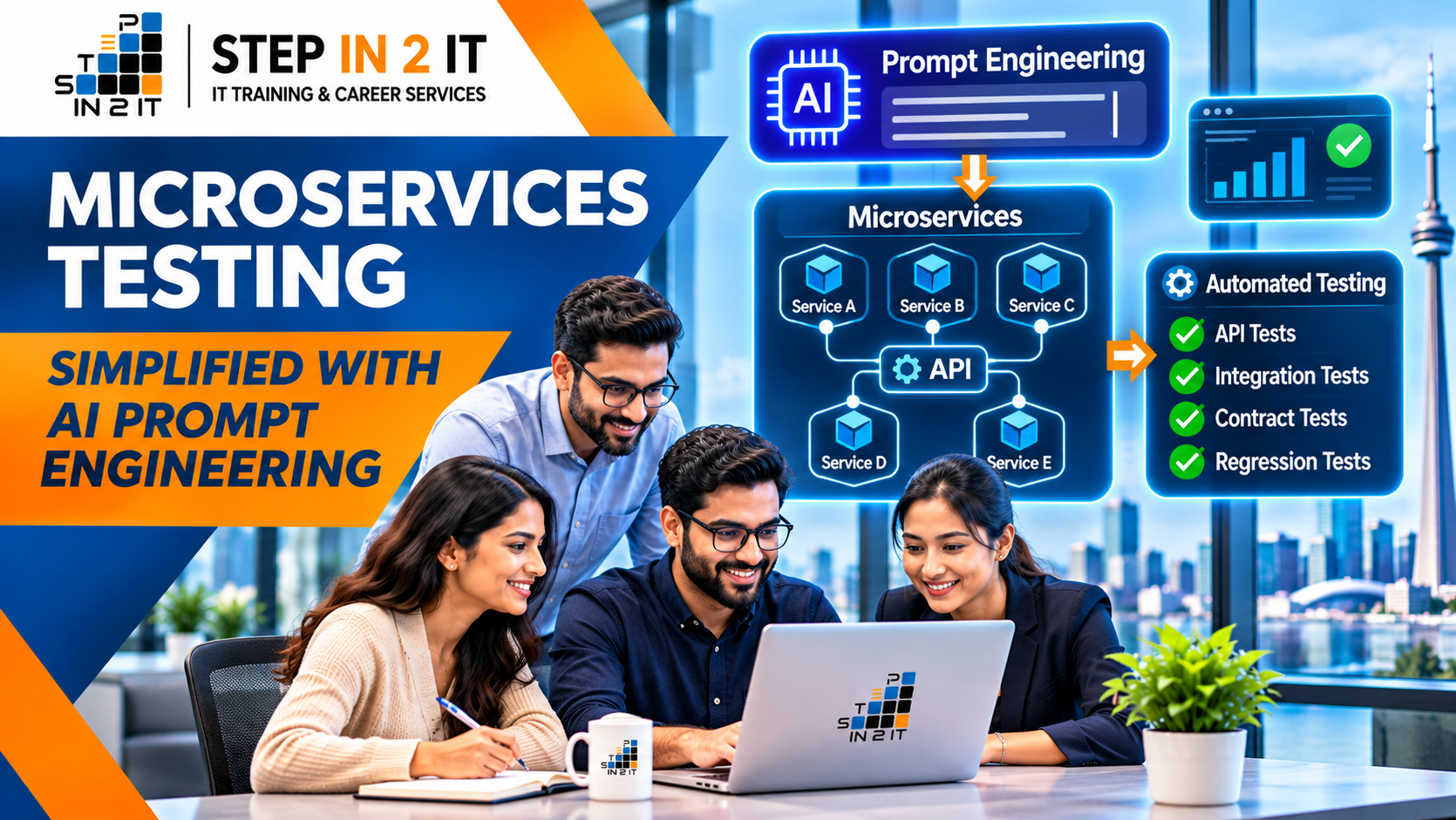
Modern applications are rarely built as one large block of code. Many organizations use a microservices architecture, where an application is divided into smaller, independently developed services. One service may manage customer accounts, another processes payments, while others handle inventory, notifications or orders.
This architecture can make systems easier to scale and update, but it also creates a testing challenge. A single customer action may travel through several services, APIs, databases and message queues. If one service changes its response format or becomes unavailable, the impact can spread across the application.
AI prompt engineering can help QA professionals organize this complexity. By giving an AI assistant clear system context, testing objectives, constraints and expected outputs, testers can use it to draft scenarios, identify edge cases, prepare API checks and investigate failures more efficiently.
1. Understanding Microservices Testing
In a microservices application, each service is responsible for a specific business capability and communicates with other services through defined interfaces. Communication may happen through REST or GraphQL APIs, gRPC, or asynchronous messaging systems such as queues and event streams.
Consider an online shopping application. When a customer places an order, the workflow may involve:
- Customer Service: verifies the customer's account and delivery information.
- Inventory Service: checks whether requested items are available.
- Order Service: creates the order and records its status.
- Payment Service: processes or authorizes payment.
- Shipping Service: prepares fulfilment and delivery details.
- Notification Service: sends an order confirmation or status update.
Testing only one endpoint will not prove that the entire order journey works. QA teams need to check individual services, service-to-service communication, data consistency, failure handling and critical end-to-end workflows.
2. Why Microservices Testing Can Be Challenging
Microservices introduce several testing concerns that are less visible in a traditional monolithic application.
- Multiple APIs and contracts: Each service may expose different endpoints, request formats, response structures and error codes.
- Independent deployments: One service may be updated while its consumers continue running an earlier version.
- Service dependencies: A test may fail because a dependent service is unavailable, slow or incorrectly configured.
- Distributed data: Information may be stored in separate databases and updated asynchronously.
- Partial failures: A workflow may complete in some services but fail in another, leaving the system in an unexpected state.
- Environment complexity: Test environments may need several services, message brokers, credentials and external integrations.
- Test maintenance: Changes to APIs and service relationships can make existing test suites outdated.
AI can help testers reason through these dependencies, but it cannot know the real architecture unless the team provides accurate documentation, API specifications, examples and business rules.
3. Where AI Prompt Engineering Fits into Microservices Testing
Prompt engineering is the practice of writing clear, structured instructions that guide an AI assistant toward a useful result. For QA work, a good prompt gives the tool enough context to produce relevant test ideas without asking it to invent missing requirements.
A useful testing prompt generally includes five elements:
- Role: Tell the AI what perspective to use, such as an experienced API test analyst.
- Context: Describe the service, its purpose, dependencies and relevant API details.
- Task: Specify exactly what you want generated or analysed.
- Constraints: State the tools, formats, security rules and assumptions it must follow.
- Output format: Request a structured table, test cases, JSON examples, assertions or a defect-analysis summary.
Instead of asking, "Create API test cases," provide the service purpose, endpoint, request schema, response examples, business rules and error conditions. This produces a more useful starting point for review.
4. Using AI to Generate Microservices API Test Scenarios
API testing is a core part of microservices quality assurance. Testers need to validate request methods, headers, authentication, payloads, response codes, schemas, business rules and error handling.
An AI assistant can help transform an OpenAPI specification or endpoint description into a draft test matrix. A tester can then review the proposed cases and implement them in tools such as Postman or an automation framework.
Example: AI prompt for API test design
This prompt encourages the AI to consider more than a successful response. It also asks the tool to identify unknowns rather than silently filling gaps with assumptions.
Postman supports scripted assertions, collections, reusable environments, mock APIs and automated collection runs. These capabilities can turn reviewed test scenarios into repeatable API checks. See the Postman documentation for API tests and scripts.
5. Simplifying Service Integration Testing
Integration testing checks whether services communicate correctly. For example, after an order is created, the Order Service may send an event that the Inventory Service uses to reserve stock. The Payment Service may then return a payment result that updates the order status.
AI can help QA teams map these interactions and identify scenarios that may otherwise be missed, including:
- A downstream service returns an unexpected response.
- A service responds more slowly than the calling service's timeout limit.
- A message is delivered more than once.
- A message arrives later than expected or out of sequence.
- A dependency is temporarily unavailable.
- A retry causes an unintended duplicate transaction.
- A service receives incomplete or inconsistent data.
Example: AI prompt for integration scenarios
The resulting scenarios should be compared with architecture diagrams, event definitions and actual business rules before they are added to a test plan.
6. Contract Testing: Preventing Service Compatibility Problems
One of the most useful approaches in a microservices environment is contract testing. A contract describes the expectations between a service consumer and a service provider, such as the request it sends and the response it relies on.
For example, a mobile application may depend on the Customer Service returning a customer identifier, account status and contact details. If the provider changes a field or its data type, the consumer may break even though the Customer Service's own tests pass.
Contract testing helps verify that service interactions continue to meet agreed expectations without relying exclusively on large, expensive end-to-end tests. Pact's documentation explains consumer-driven contract testing for HTTP and message-based integrations.
How AI can assist contract testing
- Summarize differences between two API specification versions.
- Identify fields that consumers appear to depend on.
- Suggest positive and negative contract examples.
- Highlight possible breaking changes for human review.
- Draft questions for provider and consumer teams before a release.
7. Test Data Generation for Distributed Services
Microservices testing often requires related data across several services. An order test may need a valid customer, an active product, available inventory, a payment method and a delivery address. Creating this data manually for every scenario can slow down testing.
AI can help prepare synthetic test-data ideas and structured datasets, including valid and invalid customer profiles, products with different inventory levels, orders with multiple items, payment success and decline scenarios, invalid addresses, and events with missing identifiers.
For example, ask an AI assistant to create a table of test-data combinations for an order workflow, including the expected result and the services that consume each field.
Do not use real customer information in public AI tools. Use approved synthetic data, protect credentials and tokens, and ensure that generated data respects the application's validation rules. QA teams should also confirm that test data can be safely reset and does not contaminate shared environments.
8. Using AI to Analyse Logs and Troubleshoot Failures
When a microservices workflow fails, the cause may not be obvious. A request may pass through an API gateway, Order Service, Inventory Service and Payment Service before returning an error. Each component may produce its own logs and trace information.
AI can help summarize supplied log excerpts, group related error messages and suggest investigation paths. It is particularly useful when the tester provides timestamps, correlation IDs, service names, expected behaviour and the actual result.
Example: AI prompt for defect analysis
AI-generated analysis should be treated as an investigation aid, not proof of root cause. Engineers should verify suggestions against distributed traces, metrics, service logs and reproducible test results. Remove secrets, personal information and confidential payloads before sharing diagnostic data with an AI tool.
9. Mocking and Service Virtualization
Testing every service together can be difficult when some dependencies are unavailable, expensive or still under development. Mocking and service virtualization allow teams to simulate the behaviour of a dependency so that a service can be tested in a controlled environment.
AI can help draft mock response examples, identify useful failure conditions and suggest variations in response timing or payload content. The QA engineer must ensure that the mock reflects the actual service contract and does not create unrealistic confidence.
Postman provides mock API capabilities and tools for simulating dependency conditions such as latency, errors and rate limits. Explore its API testing and mock documentation when planning this type of workflow.
10. Adding Microservices Tests to CI/CD Pipelines
Testing becomes more valuable when it runs consistently as part of the development and release process. QA teams can organize tests by scope and execution cost, then run suitable checks at different stages of the CI/CD pipeline.
| Testing level | What it validates | Typical pipeline use |
|---|---|---|
| Unit tests | Small functions and service logic in isolation | Run frequently during development and builds |
| Component tests | A service with controlled or simulated dependencies | Run during service-level validation |
| API tests | Endpoint behaviour, schemas, validation and errors | Run after service deployment to a test environment or against a controlled test instance |
| Contract tests | Compatibility between consumers and providers | Run when contracts or dependent services change |
| Integration tests | Communication and data flow across selected services | Run at integration checkpoints |
| End-to-end tests | Critical user journeys across the full application | Run selectively before release or on scheduled builds |
AI can help classify test cases, propose pipeline stages and summarize failures. It should not decide to skip critical checks without an agreed risk policy. Postman documents options for running collections manually, on a schedule and in CI/CD pipelines using its CLI. See Postman collection execution options.
11. A Practical Prompt Engineering Framework for QA Teams
To get consistent results, QA teams can adopt a reusable prompt structure rather than writing a new instruction from scratch for every task.
Teams should store approved prompt templates alongside their test documentation, review them periodically and update them when service contracts or business rules change.
12. Common Mistakes to Avoid When Using AI for Microservices Testing
- Providing too little context: Generic prompts produce generic test ideas. Include service boundaries, API details and business rules.
- Accepting invented requirements: AI may suggest status codes, retry rules or response fields that do not exist. Verify every expected result.
- Testing only happy paths: Include timeouts, partial failures, duplicate messages, invalid data and recovery behaviour.
- Overusing end-to-end tests: Large distributed tests can be slow and fragile. Use focused unit, component, API and contract tests where appropriate.
- Ignoring data privacy: Never paste credentials, production customer records or confidential logs into unapproved AI services.
- Automating without review: Generated scripts need code review, reliable assertions and repeatable execution.
- Confusing test volume with coverage: More generated cases do not necessarily mean better risk coverage. Prioritize important business behaviours.
13. Skills QA Professionals Need for AI-Assisted Microservices Testing
QA professionals do not need to become microservices architects to contribute effectively, but they should understand how distributed applications communicate and how to test their boundaries.
- Software testing fundamentals and risk-based test design.
- REST API testing, HTTP methods, status codes, headers and JSON.
- Postman collections, environments, scripts and automated runs.
- SQL and basic data validation across service workflows.
- Contract testing concepts and tools such as Pact.
- Basic understanding of logs, correlation IDs and distributed tracing.
- CI/CD concepts and automation framework fundamentals.
- Prompt engineering, critical thinking and responsible AI use.
For learners and career changers in Toronto and the GTA, combining API testing with automation and AI-assisted test design can create a practical portfolio of skills to demonstrate to prospective employers.
14. How STEP IN 2 IT Can Help You Build Practical QA Skills
Understanding modern software testing requires more than learning definitions. QA professionals need opportunities to work with test scenarios, APIs, automation tools, data and realistic workflows.
STEP IN 2 IT supports learners in Toronto and the Greater Toronto Area through software testing training and career services. Whether you are a new graduate, an IT job seeker or transitioning into technology, building a foundation in manual testing, API testing and automation can help you prepare for today's QA roles.
As you develop your skills, practise documenting test cases, validating API responses, investigating defects and explaining how you used AI responsibly. A practical portfolio can help demonstrate your approach to employers. STEP IN 2 IT also offers career guidance and job placement assistance to support learners as they work toward their career goals.
Start Building Your Software Testing Skills
Learn practical QA concepts, strengthen your API testing foundation and prepare for the evolving software quality landscape.
Frequently Asked Questions
1. What is microservices testing?
Microservices testing verifies that individual services work correctly and communicate reliably with other services through APIs, messages and shared workflows. It includes unit, component, API, contract, integration and end-to-end testing.
2. How does AI prompt engineering help with microservices testing?
AI prompt engineering helps testers provide structured instructions and relevant system context so an AI assistant can draft test scenarios, review API changes, suggest test data and summarize sanitized diagnostic information. All generated output must be checked against actual requirements.
3. Which tools are commonly used for microservices testing?
Tools depend on the application and technology stack. Common choices include Postman for API testing and collections, Pact for consumer-driven contract testing, automation frameworks for service checks, and CI/CD tools for repeatable execution.
4. What is the difference between API testing and contract testing?
API testing checks whether an endpoint behaves as expected, including its responses, validation and error handling. Contract testing checks whether a service interaction meets the expectations agreed between a consumer and a provider.
5. Can AI replace manual testing in microservices applications?
No. AI can accelerate selected test-design and analysis tasks, but human testers are still needed to understand business context, explore unexpected behaviour, validate assumptions and assess risk across complex service interactions.
6. Can beginners learn microservices testing?
Yes. Beginners should first build a foundation in software testing, HTTP, REST APIs, JSON and Postman. They can then progress to service integration, contract testing, automation, CI/CD and AI-assisted testing.
Conclusion
Microservices testing can become complex when many independently deployed services exchange data and depend on one another. AI prompt engineering gives QA professionals a practical way to organize test ideas, explore failure conditions, prepare API checks and investigate problems more efficiently.
The strongest results come from combining structured prompts with reliable testing fundamentals. Validate AI-generated scenarios, protect sensitive data, use contract and integration tests appropriately, and keep critical release decisions grounded in evidence.
For QA professionals in Toronto, Mississauga, Brampton, North York, Scarborough, Markham and across the GTA, developing API, automation and AI-assisted testing skills can be a valuable step toward a modern software quality career.
Editorial note: Tool capabilities and documentation can change. Review the linked official documentation and your organization's security and privacy requirements before adopting a tool or AI workflow.