

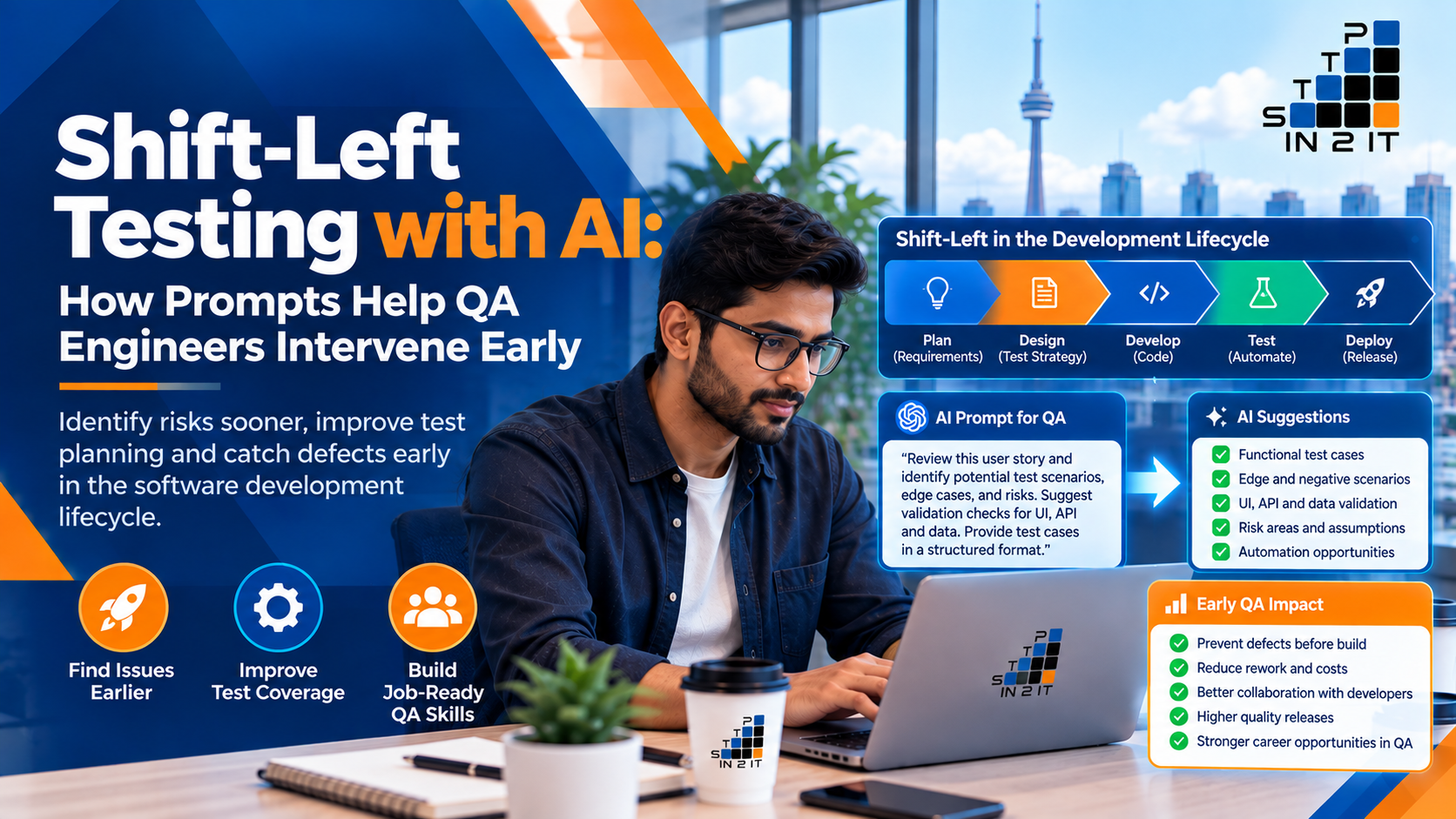
Shift-Left Testing with AI: How Prompts Help QA Engineers Intervene Early
Learn how AI prompts can help QA engineers review requirements, uncover risks and design stronger tests before defects move further through development.
The cheapest time to find a software defect is often before anyone has written the code that introduces it.
Imagine a team building a registration feature. Development is already underway when QA discovers that the requirements never explain what should happen if a user submits an email address that is already registered. The team now has to clarify the rule, change the implementation and retest the feature.
That problem may have been easier to resolve during requirements review. This is the thinking behind shift-left testing: involve testing earlier in the software development lifecycle instead of leaving most testing until the end.
Generative AI gives QA engineers another way to contribute early. With a well-written prompt, an AI tool can help review a user story, suggest edge cases, identify unanswered questions or draft initial test scenarios. Its suggestions still need human judgement, but they can give the team a useful starting point before development moves too far ahead.
For new graduates, career changers and QA job seekers in Toronto, Brampton, Mississauga, Scarborough and across the GTA, learning this approach can build skills in test design, risk analysis, communication and responsible AI use.
Shift-left testing isn’t about testing everything earlier. It’s about asking the right quality questions while the team can still act on the answers.
01. What is shift-left testing?
In a traditional workflow, testing can become concentrated after development is complete. Shift-left testing moves quality activities earlier, often into planning, requirements analysis, design and coding. QA works with product owners, business analysts and developers to identify risks and clarify expected behaviour before those questions become expensive rework.
Review requirements before coding
Look for missing acceptance criteria, unclear business rules, contradictory statements and conditions that have not been addressed.
Design tests alongside development
Identify positive, negative, boundary and error-handling scenarios while the team is still discussing how a feature should work.
Automate useful checks early
Where appropriate, prepare unit, API or component-level checks that can run as implementation evolves.
Make quality a shared responsibility
QA helps the team prevent and detect issues; developers and product stakeholders also contribute to clear requirements and reliable releases.
02. How AI prompts can support early QA
An AI prompt tells a model what to review, what context to use and what kind of answer to return. Specific prompts can help QA engineers examine a requirement from different angles rather than relying on the first interpretation that comes to mind.
- Find gaps in a user story: ask AI to identify ambiguous terms, missing acceptance criteria, dependencies and questions the product owner should answer.
- Suggest risk-based scenarios: request positive, negative, boundary and failure cases, then prioritize them according to business impact and likelihood.
- Prepare refinement questions: create a concise list of decisions that need clarification before the team estimates or builds the feature.
- Draft test documentation: structure test cases, test data ideas or traceability tables, then verify the final content against approved requirements.
AI is useful as a thinking partner, not as the authority on what a feature should do. If the business rule is missing, the correct next step is usually to ask for clarification—not to let a model invent the rule.
03. Four prompts QA engineers can use
Good prompts provide context, define the task and ask the model to separate facts from assumptions. Use approved tools and fictional or non-sensitive examples.
Prompt 1: Review a user story
“Review the user story and acceptance criteria below. Identify ambiguous wording, missing business rules, dependencies and unanswered questions. Do not invent requirements. Return a table with the issue, why it matters and a question the team should resolve before development.”
Prompt 2: Generate test scenarios
“Based only on the stated requirements, propose positive, negative, boundary and error-handling test scenarios. For each, include the precondition, test data, action, expected result and linked acceptance criterion. Mark any expected result that needs clarification.”
Prompt 3: Identify risk areas
“Assess this feature for potential quality risks involving validation, permissions, data integrity, integration failures and usability. Rank risks by potential impact and explain the evidence for each ranking. Separate confirmed facts from assumptions.”
Prompt 4: Prepare for refinement
“Create a short list of high-value questions QA should ask the product owner and developer before implementation. Focus on unclear behaviour, edge cases, error messages, accessibility, security-related expectations and testability. Do not claim an unstated requirement is mandatory.”
04. Example: shift-left testing for password reset
Suppose a team is planning a password reset feature. A basic user story might say: “As a user, I want to reset my password so I can regain access to my account.” That describes the goal, but it leaves several important questions unanswered.
Requirements to clarify
How long is a reset link valid? Can it be used more than once? What message appears if the email address is not registered? What happens if a user requests multiple links?
Test ideas to consider
Expired links, reused links, malformed email addresses, repeated requests, successful resets, password policy validation and attempts to use the old password.
Where AI helps
A prompt can organize questions and propose additional scenarios. The product and engineering team must still decide the intended behaviour and document the approved rules.
Because password reset involves account security, QA should follow the team’s approved security requirements and testing procedures. AI-generated suggestions are not a substitute for a security review.
05. A practical shift-left workflow
- Read the story and acceptance criteria. Understand the user goal, expected behaviour, dependencies and constraints.
- Use AI to broaden the review. Ask for ambiguities, edge cases, risks and questions. Use approved tools for work-related information.
- Validate suggestions with the team. Discuss useful questions with the product owner, business analyst and developer. Record decisions in the requirements.
- Create test cases and automation candidates. Turn approved requirements into test cases and identify checks suitable for unit, API, integration, UI or end-to-end testing.
- Review outcomes and improve. When defects occur, consider whether a requirement question or test could have identified the risk earlier. Not every defect can be prevented.
06. Mistakes to avoid when using AI
- Accepting invented requirements: AI may fill gaps with plausible but incorrect assumptions. Get decisions from the people responsible for the product.
- Writing vague prompts: “Find bugs in this feature” gives little direction. Provide the user story, acceptance criteria, constraints and a specific output format.
- Sharing confidential information: never paste credentials, personal data, source code or proprietary requirements into an unapproved AI tool.
- Measuring success by test count alone: more test cases are not automatically better. Prioritize relevant risks, clear expected results and meaningful coverage.
07. Skills to build for modern QA careers
Shift-left testing is as much about communication and reasoning as it is about tools. QA engineers need to understand requirements, ask precise questions, assess risk, design meaningful tests and explain findings clearly to the team.
For new graduates and career changers, start with software testing fundamentals: test levels, test design techniques, defect reporting, acceptance criteria and regression testing. Then practise writing structured prompts and checking AI output. Add API testing and browser automation as your foundation grows, choosing tools that align with the roles you want to pursue.
If you’re exploring QA training in Toronto, Brampton, Mississauga, Scarborough or elsewhere in the GTA, review the current course syllabus and ask whether it covers AI-assisted test design, requirements analysis or automation. These topics should be confirmed directly rather than assumed from a general software testing course description.
When considering QA training and job placement assistance in Canada, ask providers what career support is available and what it includes. Support can help with preparation and job-search activities, but it does not guarantee employment.
08. How STEP IN 2 IT can help
STEP IN 2 IT lists software testing training, Selenium automation training and ISTQB CTFL preparation on its public website. These can be starting points for developing a QA foundation. Contact STEP IN 2 IT to confirm whether shift-left practices and AI-assisted test design are included in the current syllabus before enrolling.
Ready to strengthen your QA foundation?
Practise reviewing requirements, asking better testing questions and turning approved acceptance criteria into useful test cases. Explore current training options and ask about any available job placement assistance.
09. Frequently asked questions
What is shift-left testing in software QA?
Shift-left testing brings quality activities earlier into planning, requirements, design and development so teams can identify ambiguity and potential defects sooner.
How can AI prompts help QA engineers?
Prompts can help review user stories, identify questions, suggest edge cases, draft test scenarios and organize risk analysis. QA engineers must validate suggestions against approved requirements.
Does shift-left testing mean testing starts before coding?
Often, yes. It can include reviewing requirements and designing tests before implementation, while testing continues throughout development and after code is available.
Can AI replace a QA engineer in shift-left testing?
AI can assist with analysis and drafting, but it cannot independently determine every business requirement or take responsibility for quality decisions. Human judgement and collaboration remain important.
Does STEP IN 2 IT teach shift-left testing with AI prompts?
The public course information referenced for this article does not confirm a dedicated module on shift-left testing with AI prompts. Contact STEP IN 2 IT to verify the current syllabus.
Bring quality into the conversation earlier.
Build a strong testing foundation, practise clear test design and learn how to assess AI suggestions with confidence.
Further reading: ISTQB software testing resources · STEP IN 2 IT Software Testing Program · STEP IN 2 IT training programs. Confirm current course details before publishing specific training claims.